 SEAL CONNECT
Sealing Dry Powders and Bulk Solids: When to Use an Air Seal

An air seal uses clean, dry air or gas, supplied above vessel pressure, to keep product out of the shaft seal area. It replaces the flush water packing needs and the liquid film mechanical seals need, neither of which works with dry solids.
Mixers, ribbon blenders, screw conveyors, and rotary airlocks handling dry solids are hard on conventional seals. Packing needs flush water to cool and lubricate it. Mechanical seals need a liquid between the faces, from a barrier fluid or the process itself. Dry powder offers neither. Flush water turns product into paste or contaminates the batch, and faces run dry on abrasive fines wear out fast.
Why do packing and mechanical seals fail on dry powders?
- Abrasion. Fines work between packing rings and between seal faces and grind them down. Packing also scores the sleeve, so you replace two parts instead of one.
- Packing up. Powder fills springs, bellows, and the gap between the sleeve and gland. Once the springs hang up, the faces open and product gets between them.
- Shaft movement. Mixers and conveyors often run with more deflection and runout than a pump seal is built for. Faces separate, and powder gets in.
- Product migration. Leaked powder doesn’t stay at the seal. It drifts into the vessel bearings and nearby equipment, and those bearing failures usually get blamed on something else.
- Product loss and housekeeping. Every pound that leaks is a pound you paid for and someone has to sweep up.
 How does an air seal work?
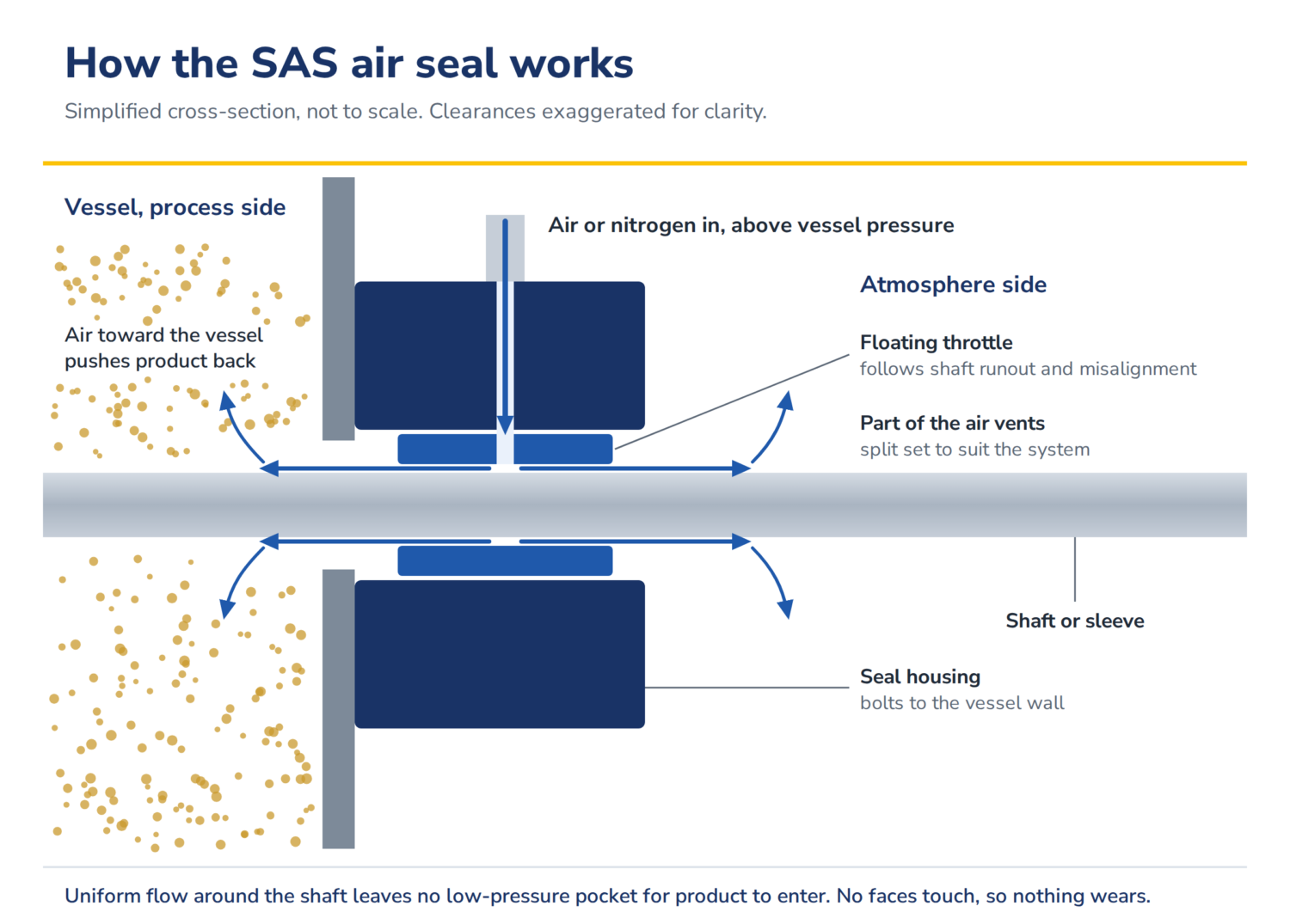
The SEPCO SAS Air Seal is a non-contact pneumatic seal. Engineered clearances between a floating throttle and the shaft or sleeve create a uniform pressure and velocity profile around the shaft.
Part of the air flows toward the vessel and pushes product back. The rest vents to atmosphere, and the split is set to suit the system. The uniform profile leaves no low-pressure pockets for product to enter. With no rubbing faces, abrasives have nothing to wear.
The floating throttle follows the shaft. The standard SAS has these limits:
- Working pressure: up to 120 psi
- Parallel misalignment: 0.0625 in. TIR
- Angular misalignment: 1.5°
Where angular misalignment is significant, use the SAS-M. Split designs are available in most sizes for retrofits on existing equipment.
Typical applications include mixers, blenders, agitators, screw conveyors, hoppers, and rotary airlocks. For CEMA screw conveyors, SEPCO also makes a dedicated CEMA Air Seal.
 What does an air seal need to run reliably?
- Clean, dry air. Water and oil in plant air bind with powder and foul the seal. Filter and regulate the supply.
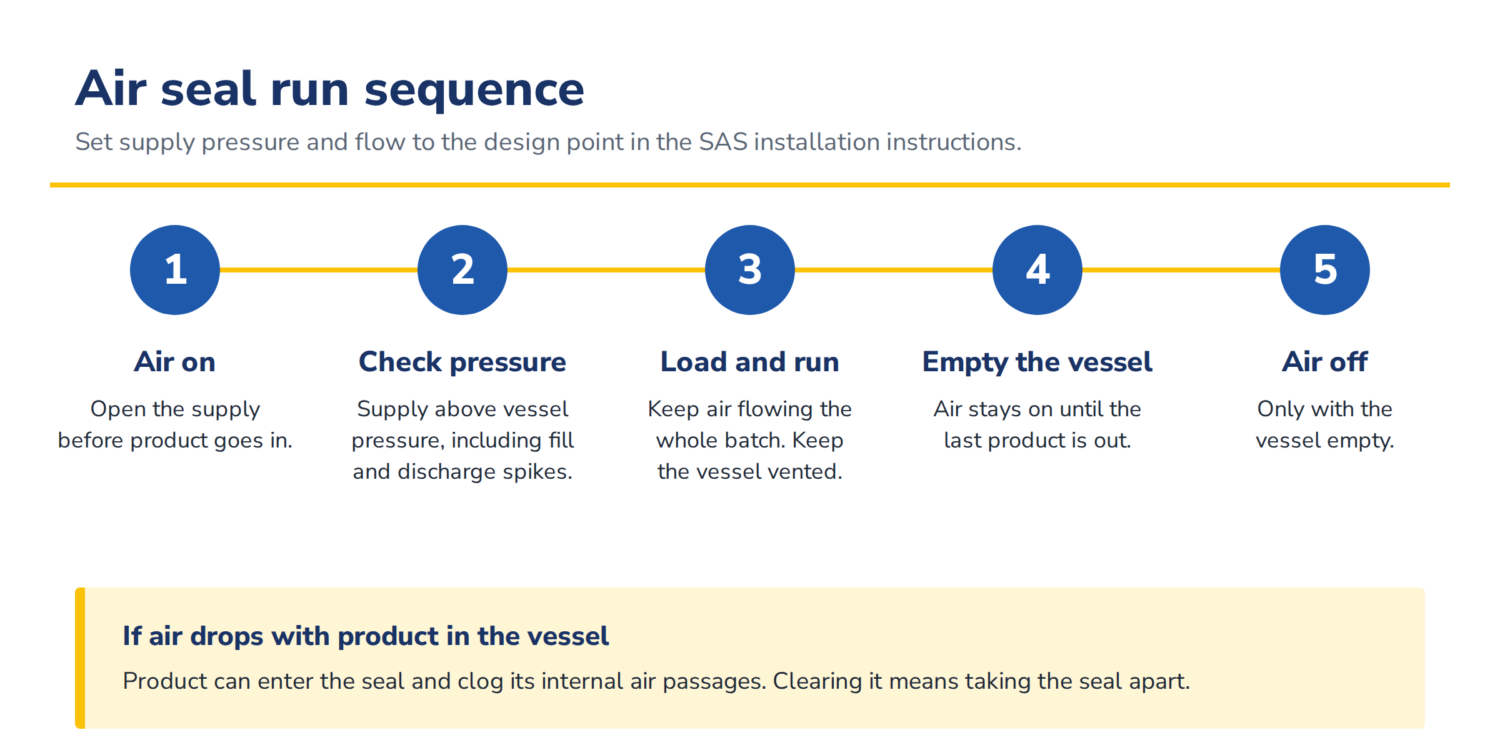
- Air pressure above vessel pressure at all times, including the spikes during filling and discharge. If vessel pressure exceeds the supply, product moves into the seal.
- A vented vessel. The air entering the vessel has to go somewhere. An unvented vessel can be over-pressurized by its own seal.
- Air on before product goes in, off only after the vessel is empty. If air drops with product in the vessel, product can enter the seal and clog the internal air passages. The seal then has to come apart for cleaning.
- A process that can take the gas. For inerted vessels, or products sensitive to oxygen or moisture, run nitrogen instead.
Supply pressure and flow depend on size, model, and system conditions. Set them to the design point in the installation and maintenance instructions. Download those by registering your SAS on the product page.
When should you not use an air seal?
- The product can’t tolerate any air or gas, and there’s no compatible gas to use instead.
- The vessel can’t be vented.
- There’s no reliable air or nitrogen supply at the equipment. An air seal is only as dependable as its supply.
- The pump is in hazardous service. SEPCO’s pump air seal systems are designed for non-hazardous services. Use a mechanical seal for hazardous pump service.
Sizing an air seal
To size an SAS, SEPCO’s application engineers need:
- equipment make and model
- vessel pressure, including peaks
- shaft size and speed
- measured runout and deflection
- product
- temperature
SEPCO also trains plant crews on installation and setup.
For other sealing options on this equipment, see SEPCO Customized Seals for Mixers, Agitators, and Vessels. For more on air seal operation, see Managing the Difficult-to-Seal.
Frequently asked questions
Can a mechanical seal run on dry powder?
A standard pump-style seal won’t last long. Without a liquid film the faces run dry, fines get between them, and powder packs the springs until the faces hang open.
What happens if the air supply fails?
Product can enter the seal and clog the internal air passages, and the seal has to be disassembled and cleaned. Keep air on before product enters the vessel and until it’s empty.
Can I use nitrogen instead of plant air?
Yes. Use nitrogen for inerted vessels or products sensitive to oxygen or moisture.
Does an air seal work on slurries?
Yes. The SAS is designed for wet or dry service. For centrifugal pumps moving slurries, the SAS-P system adds a water flush, two shaft-supporting bushings, and a lantern ring. Air pressure is set 10 psi over flush water pressure.
Can an air seal be cleaned in place?
Yes. Hot water or FDA-approved cleaning solutions can be injected through the air supply port without taking the seal apart.
How much shaft misalignment can an air seal handle?
The standard SAS handles 0.0625 in. TIR parallel and 1.5° angular. For larger angular misalignment, use the SAS-M.
 Find Your Sealing Solution