 SEAL CONNECT
API 622 Valve Packing: What the Test Proves and Where SEPCO Style 622 Fits
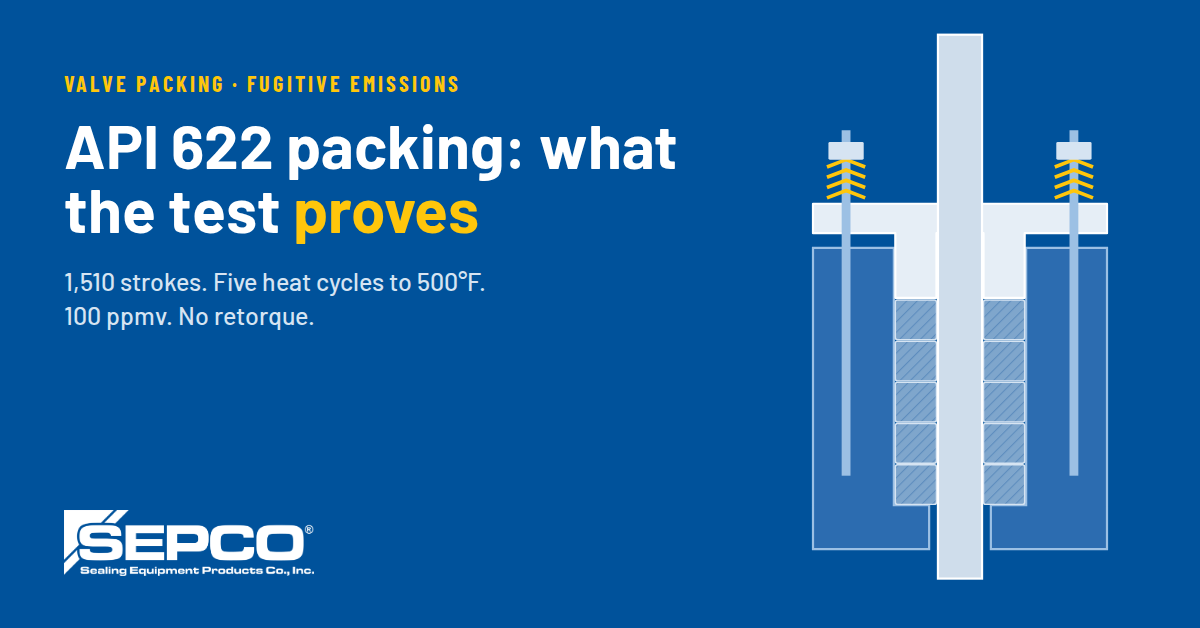 Valve stems are the biggest single source of fugitive emissions in a refinery or chemical plant, and the packing is the only thing between the process and the LDAR monitor. API 622 is the test the industry uses to compare stem packings for that job. SEPCO Style 622 is built to pass it.
Get the wording right first. API doesn’t certify packing. API 622 is a type test: the manufacturer runs a packing set through it, usually at an independent lab, and gets a test report. “Tested to API 622” is the accurate claim. “API 622 certified” is not. Either way, the report is the proof.
 What the API 622 test does
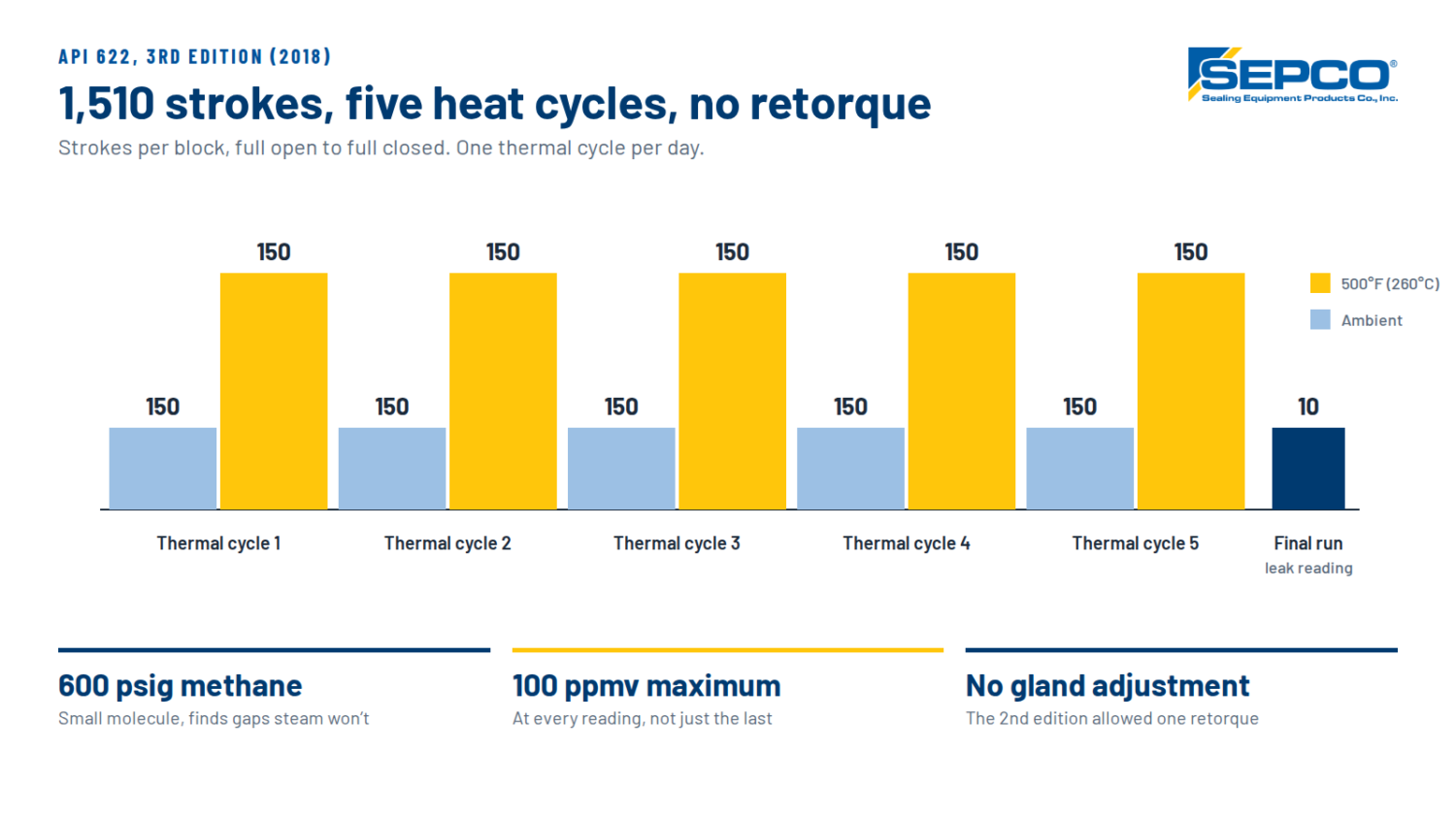
API 622 strokes a valve stem through a packing set while methane at 600 psig sits behind it, and measures leakage at the gland the whole way. The current edition is the third, published in 2018.
| Test parameter | API 622, 3rd edition |
|---|---|
| Test gas | Methane |
| Pressure | 600 psig |
| Mechanical cycles | 1,510 strokes, full open to full closed |
| Thermal cycles | 5, ambient to 500°F (260°C), one per day |
| Each thermal cycle | 150 strokes at ambient, then 150 at 500°F |
| Final run | 10 strokes at ambient; final leak reading taken here |
| Maximum leakage | 100 ppmv at any reading |
| Gland adjustments | None allowed |
Methane is the test gas because it’s a small molecule. It finds gaps that steam and heavier hydrocarbons won’t. The standard also weighs corrosion, because packing that pits the stem cuts its own leak path.
The third edition set the 100 ppmv ceiling and dropped the one gland retorque the second edition allowed mid-test. If a report predates 2018, read it with that in mind.
 What a pass proves, and what it doesn’t
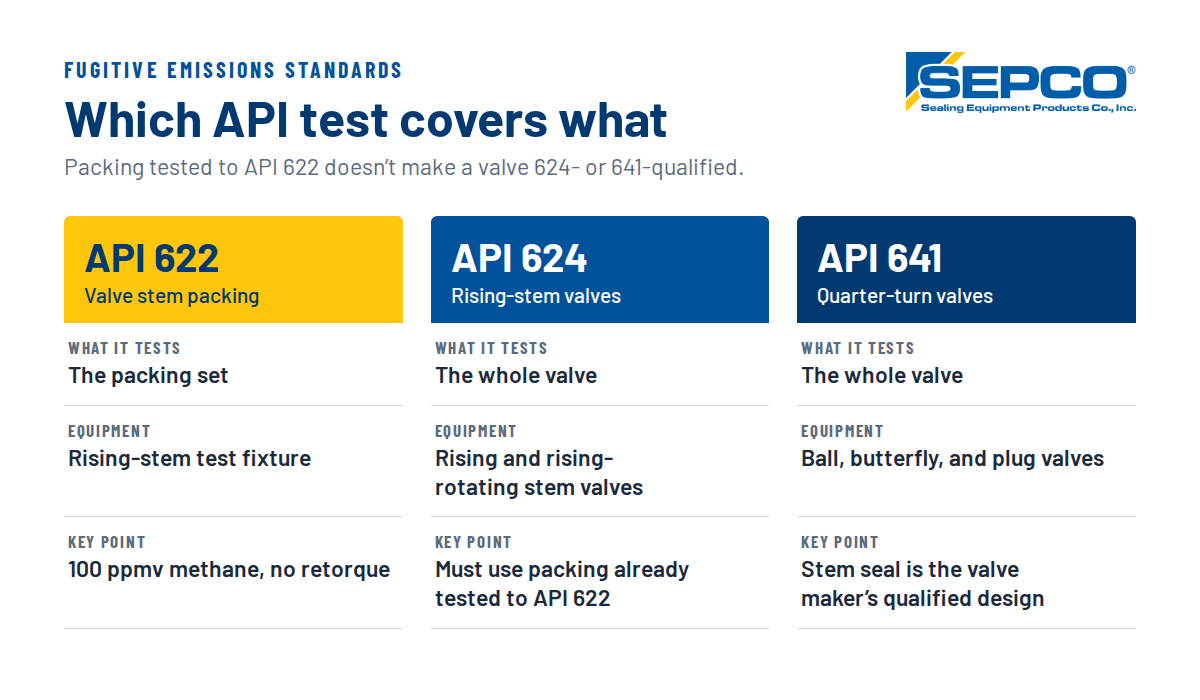
A pass qualifies a packing design: the material, braid, and cross-section that went through the fixture. It does not qualify your valve or your installation.
- It’s not a valve test. API 624 tests rising-stem and rising-rotating-stem valves: 310 strokes, three thermal cycles to 500°F, 100 ppmv. A valve going to API 624 must carry packing already tested to API 622, but putting 622-tested packing in a valve doesn’t make the valve 624-qualified.
- It doesn’t cover quarter-turn valves. Ball and butterfly valves fall under API 641. A packing tested on a rising-stem fixture tells you little about a stem that rotates 90 degrees.
- Lab ppmv isn’t your LDAR number. Depending on the rule your site runs under, a Method 21 valve leak is defined somewhere between 500 and 10,000 ppm. A packing that held under 100 ppmv in the lab will still trip 500 ppm on a scored stem or an unevenly loaded gland.
- It’s tied to where the packing is made. Both standards call for requalification when the manufacturing location changes.
Ask for the report, ours included. Check the edition, every leak reading across the test, the packing configuration and ring count, the stem size, and the gland load used. A summary line on a datasheet is not a report.
SEPCO Style 622 at a glance
Style 622 is a braided valve packing for high-temperature valves and pressure vessels in steam, hydrocarbon, and nonoxidizing chemical service.
| Property | Style 622 |
|---|---|
| Maximum temperature | 1250°F (676°C) |
| Maximum pressure | 5,000 psi |
| pH range | 0–14 |
| Construction | Braided, nonhardening; does not shrink |
| Forms | Die-forms well into rings |
| Recommended equipment | Valves and pressure vessels |
| Emissions testing | Tested to API 622 |
Read those as separate ceilings, not one operating point. Pressure capability drops as temperature climbs, and the 1250°F figure applies to the nonoxidizing services named above. In hot air or oxidizing media the limit is lower. The API 622 test itself only goes to 500°F, so the 1250°F rating comes from the material, not the emissions test. Send us the full condition set: media, temperature, pressure, stem size, and stroke frequency.
Nonhardening matters more than it sounds. Packing that hardens after a few heat cycles can’t follow gland load, and the leak starts at the next thermal swing.
Where Style 622 fits, and where to use something else
Style 622 belongs in rising-stem gate and globe valves on LDAR-monitored lines in steam, hydrocarbon, and nonoxidizing chemical service. It’s a good repack for block valves that keep showing up on the Method 21 list, and for valve OEMs who need 622-tested packing before an API 624 run.
Use something else when:
- The media is a strong oxidizer. The datasheet limits Style 622 to nonoxidizing chemicals. Look at a PTFE-based set inside its temperature limit.
- The valve is quarter-turn. Ball and butterfly stems need a seal qualified for that motion, usually the valve maker’s design under API 641.
- The valve strokes constantly. A control valve cycling all day puts more strokes on braided packing in a month than a block valve sees in years. A low-friction PTFE V-ring set or the OEM’s live-loaded set usually lasts longer.
- No leak is acceptable. For toxic service where any detectable release is a problem, specify a bellows-seal valve. Packing of any kind is the wrong answer there.
- The shaft rotates. Style 622 is recommended for valves and pressure vessels, not pump stuffing boxes.
- The valve is worn out. No packing seals a pitted stem or an oval bore. Repair the valve first.
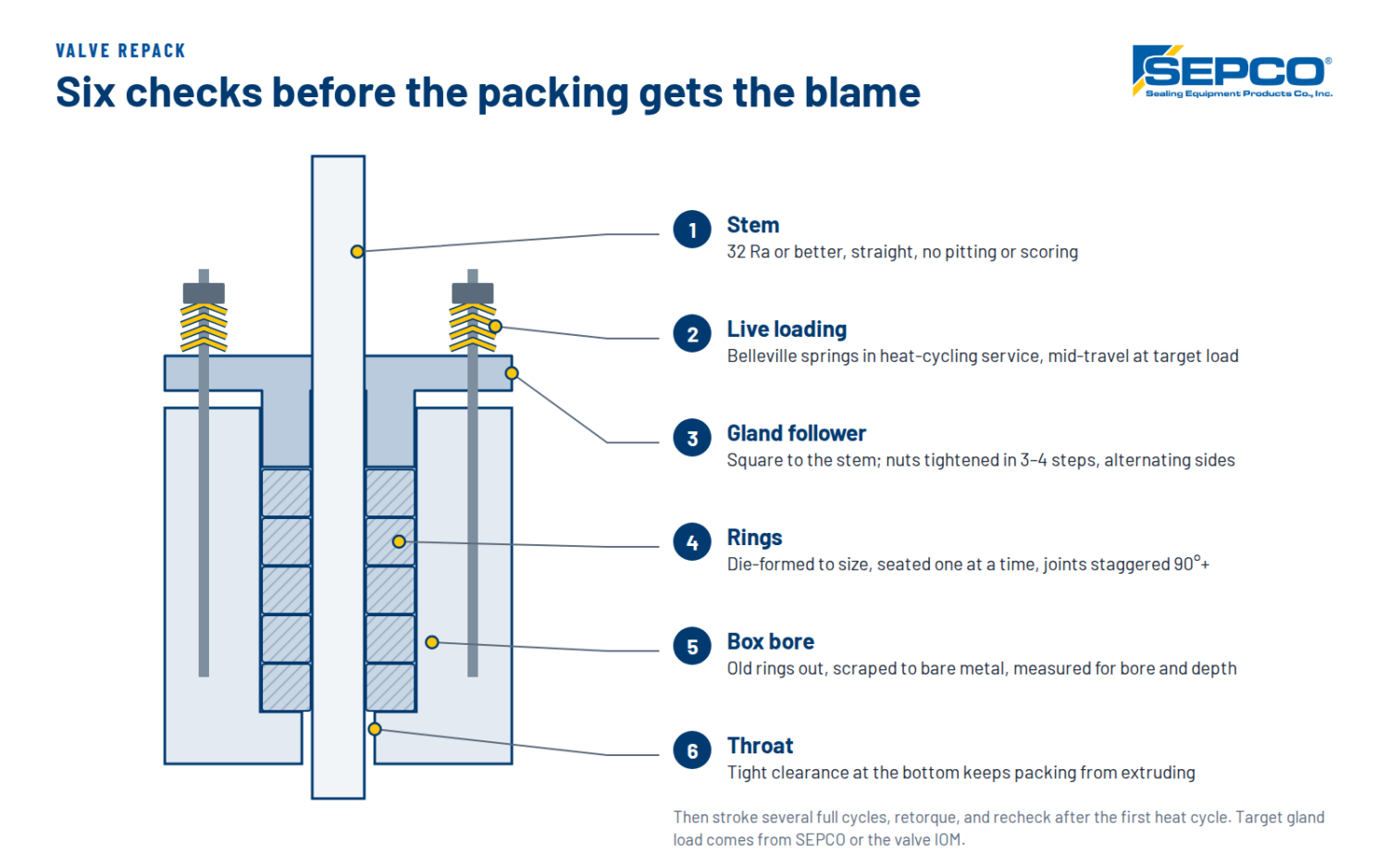 Installing it so it performs like the test
Most valves that fail LDAR after a repack fail on the installation, not the packing. The lab fixture has a new stem, a clean box, and a measured gland load. Give your valve the same.
- Check the stem. Look for scoring, pitting, and corrosion in the packing zone. Most fugitive-emissions packing makers call for a 32 Ra finish or better. Check straightness with a dial indicator against the valve maker’s IOM limit.
- Clean and measure the box. Remove every old ring and scrape the bore to bare metal. Measure stem diameter, bore, and depth, and check the bore for pitting. Large clearances at the gland follower or the bottom of the box let packing extrude.
- Size the rings. Die-formed rings to the measured stem and bore are the best choice. If you cut from braid, wrap it on a mandrel the same size as the stem and cut cleanly. Stagger the joints at least 90 degrees.
- Seat each ring on its own. Push each ring to the bottom with a split tamping tool before the next goes in. Ten rings dropped in loose and pulled down by the gland won’t load evenly.
- Load the gland in steps. Tighten the gland nuts in 3 or 4 increments up to the target torque, alternating sides, and keep the follower square to the stem. Get the target from us or the valve maker. Don’t guess it.
- Stroke, then retorque. Stroke the valve several full cycles, then bring the nuts back to target. The packing consolidates on those first strokes.
- Live-load where the valve heat-cycles. Belleville springs on the gland studs hold load as the packing consolidates through thermal swings. Size the stack so the springs sit mid-travel at target load, not flat.
- Recheck after the first heat cycle. Without live loading, recheck gland torque once the valve reaches operating temperature. Then take a Method 21 baseline reading so you know where the valve started.
FAQ
Is SEPCO Style 622 API 622 certified? API doesn’t certify packing. Style 622 is tested to API 622. Ask us for the test report.
What leakage does API 622 allow? The third edition (2018) allows 100 ppmv of methane at any reading, with no gland adjustment during the test.
Does API 622 packing make a valve API 624 compliant? No. API 624 is a separate test of the whole valve. It requires packing already tested to API 622, but the valve has to pass on its own.
Can I use API 622 packing in a ball or butterfly valve? Quarter-turn valves are qualified under API 641. Use the stem seal the valve maker qualified for that design.
How hot does the API 622 test run? 500°F (260°C). Style 622’s 1250°F (676°C) rating comes from the material in nonoxidizing service, not the emissions test.
Why does a valve leak after a repack with API 622 packing? Usually the stem, the box, or the gland load. A scored stem, loose-dropped rings, or uneven nut torque will put a lab-proven packing over your leak definition.
Sources
- SEPCO Style 622 product page and data sheet
- API 622: Valve Packing for Fugitive Emissions, Pumps & Systems, May 2019
- Update: API Standards on Fugitive Emissions, Valve Magazine, February 2016
- Emissions valve packing technology evolves to reduce methane leaks, Pumps & Systems
 Find Your Sealing Solution