 SEAL CONNECT
Expeller Bearing Isolators vs. Magnetic Face Bearing Seals: Where Each One Belongs
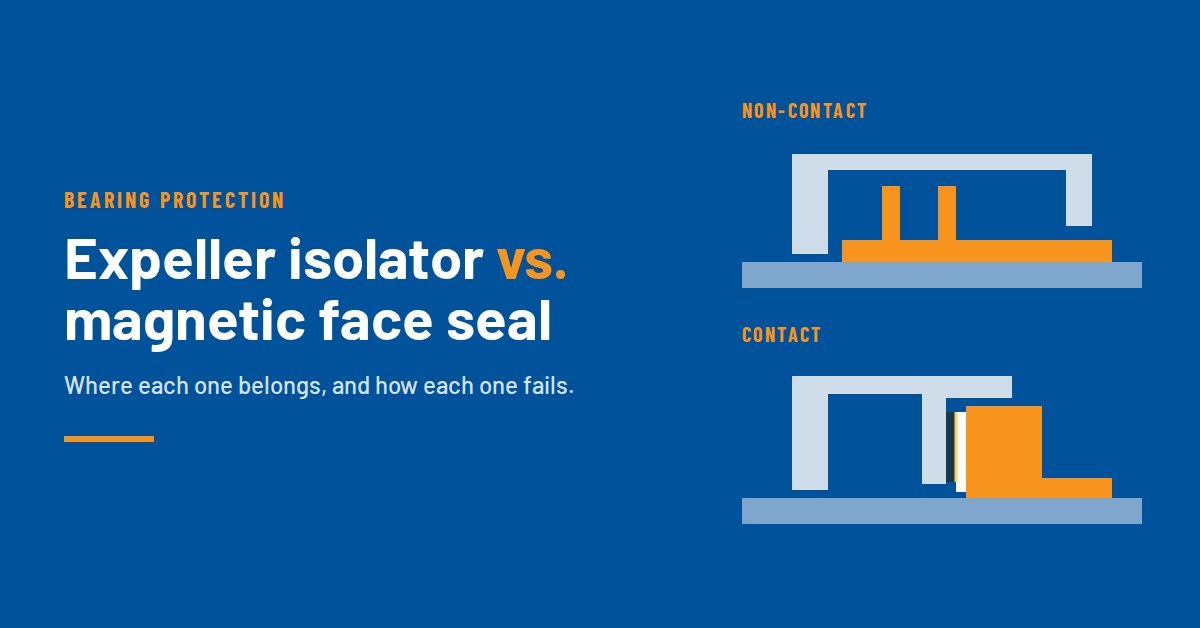 The short answer: An expeller-labyrinth isolator like the SEPCO EXP belongs on splash- and ring-oiled housings where the oil level sits below the shaft, at surface speeds above what a face seal is rated for, and in dusty or wet areas where the shaft keeps turning. A magnetic face bearing seal belongs where the housing must stay sealed at standstill: flooded housings, oil mist you need to contain, a few psi of housing pressure, or washdown while the machine is idle. Neither one fixes a bent shaft, a soft foot, or oil that’s already wet.
 How an expeller-labyrinth isolator works
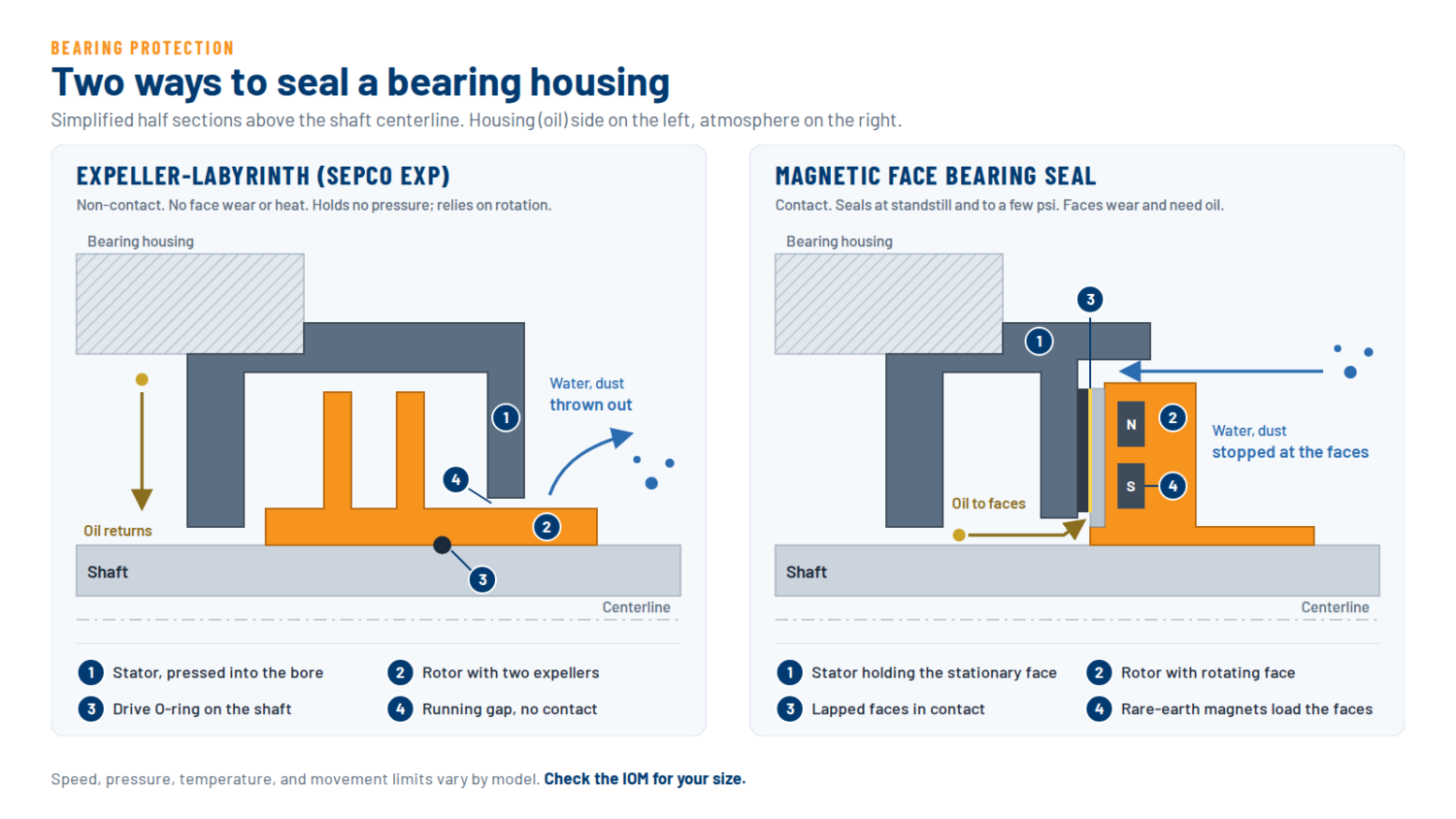
The stator presses into the housing bore. The rotor rides on the shaft, driven by an O-ring, and turns with it. Rotor and stator never touch.
While the shaft turns, the rotor’s expeller throws water and dirt outward and out the expulsion port at 6 o’clock. Oil that reaches the inboard side collects and drains back to the sump. The SEPCO EXP runs two expellers inside a labyrinth path, with two static O-rings that coalesce vapor and route it to the expulsion chamber.
Because nothing rubs, there’s no face wear, no frictional heat, and no shaft groove. Speed is limited by the rotor and O-ring, not by a sliding contact. Check the IOM for the limit on your size and version.
One exception: the EXP-GB for gearboxes adds a lip seal. That lip contacts the shaft, so treat the EXP-GB like a contact seal for speed, heat, and wear.
Where it fails
- At standstill. The expeller only works while the shaft turns. A housing that cools after shutdown pulls in outside air, and the moisture with it. In a humid plant with frequent starts, that condensate ends up in the sump. A desiccant breather helps.
- Oil level too high. A labyrinth can’t hold a static head of oil. If the level sits at or above the isolator bore, it will weep. Set the level per the IOM, usually at the center of the lowest rolling element.
- Ports off 6 o’clock. Install the expulsion and drain ports anywhere else and contaminants drain in instead of out.
- Radial movement past the clearance. Runout, deflection, or loose bearings that exceed the rotor-to-stator gap cause a rub. Measure TIR at the seal location before installing.
- Housing pressure. A labyrinth holds no differential. Purge mist and any housing pressure vent through it.
- A hose on a stopped machine. Direct washdown at the isolator, with the shaft idle, can drive water past the labyrinth.
How a magnetic face bearing seal works
A stationary face, usually carbon-filled PTFE or carbon-graphite, sits in the stator. A rotating stainless face turns with the shaft. Rare-earth magnets pull the two lapped faces together, so the seal holds whether the shaft is turning or stopped.
The faces run on oil splash, mist, or flood from the housing side, at roughly atmospheric pressure. That’s enough. Face loading is light and the faces only have to hold back a few psi at most. The 15–30 psi over seal chamber rule belongs to barrier systems on dual mechanical seals, not to bearing housing seals.
Published limits vary widely by manufacturer. Current data sheets run from about 3,900 to 15,000 fpm surface speed, 0–5 psi housing pressure, and 300–400°F. Axial and radial movement limits can be as tight as ±0.010 in. Read the data sheet for the exact seal you’re quoting.
Where it fails
- Faces wear. Any contact seal has a wear life. Life depends on how well oil reaches the faces.
- Dry faces at the seal location. A low oil level, or a ring oiler that throws little splash toward the seal, leaves the faces starved. Expect heat, glazed carbon, and accelerated wear.
- Axial movement past rating. Thrust bearing endplay and thermal growth change face loading. Set the rotor position exactly as the instructions say.
- Iron in the oil. Magnets attract ferrous wear particles. Good designs place the magnets to keep debris off the faces, but a housing that is already making iron will load the seal.
- Surface speed over rating. Above the limit, face heat climbs faster than splash can carry it away.
- A housing that can’t breathe. Fully sealed, a housing pressurizes when it heats and pulls a vacuum when it cools. Keep a breather and keep the cycle inside the seal’s pressure rating.
Which one to use
Start from the housing, not the catalog. Where we’d put a magnetic face seal over our own EXP, the table says so.
| Condition | Lean toward | Why |
|---|---|---|
| Splash or ring oil, level below the shaft | EXP | No contact, no wear, no heat |
| Surface speed above the face seal’s rating | EXP | No sliding contact to overheat |
| Dust, slurry spray, or water while running | EXP | Expeller adds energy to contaminants and throws them out |
| Flooded housing, oil at or above the seal | Magnetic face | A labyrinth can’t hold a static oil head |
| Pure or purge oil mist that must stay in | Magnetic face | A labyrinth vents mist by design |
| Housing pressure up to a few psi | Magnetic face, within rating | A labyrinth holds no differential |
| Washdown while the machine is stopped | Magnetic face | Seals at standstill |
| Gearbox | EXP-GB or magnetic face | Depends on speed and oil level; check both IOMs |
| Humid area, frequent starts, oil below the shaft | Either | EXP with a desiccant breather, or a face seal that blocks breathing |
| Runout or loose bearings | Neither yet | Fix the machine first; both designs have movement limits |
What to measure before you choose
Get these numbers before you call anyone, us included.
- Shaft surface speed. fpm = 0.2618 × shaft diameter (in) × rpm. A 2.5 in shaft at 3,600 rpm runs 2,356 fpm. A 4 in shaft at 3,600 rpm runs 3,770 fpm, already near the limit of some face seals.
- Oil level against the shaft. Below the shaft, at the shaft, or flooded. This decides more than anything else.
- Lubrication method. Splash, ring oil, constant-level oiler, pure mist, purge mist, or circulating.
- Housing pressure and venting. Is there a breather, and what kind?
- Radial runout at the seal location. Dial indicator, shaft turned by hand, TIR recorded.
- Axial endplay. Push-pull the shaft with an indicator on the end.
- Housing bore and shaft condition. Bore roundness and finish for the stator fit; shaft finish and any grooving under the O-ring.
- Environment. Washdown frequency, dust load, humidity, and normal oil temperature.
Installation mistakes that look like seal failure
A lot of failed isolators never wore out. They went in wrong. These apply to both designs.
- Cut shaft O-ring. Keyways, set-screw holes, and sharp shaft steps slice the O-ring on the way in. Tape the keyway and break the edges.
- Stator cocked in the bore. Drive it square with a flat plate and an arbor press or soft mallet, never a punch on one side.
- Wrong oil level after the job. A constant-level oiler reset to the wrong height floods a labyrinth or starves a face. Check the level against the IOM before startup.
- Painted ports. Paint over the expulsion or drain port and a labyrinth can’t drain. Mask it.
- Old bearing damage left in place. Swapping the seal on a housing full of iron and water only moves the failure. Flush the housing and change the oil.
SEPCO runs failure analysis on returned seals at no charge. Send the parts, the oil sample if you have one, and the operating data.
FAQ
Do magnetic face bearing seals need pressurized oil to lubricate the faces? No. They run on splash, mist, or flood at about atmospheric pressure. Barrier pressure 15–30 psi over the seal chamber applies to dual mechanical seals, not bearing housing seals.
Is the SEPCO EXP a non-contact bearing isolator? The rotor and stator don’t touch on the standard EXP. The EXP-GB for gearboxes adds a lip seal that contacts the shaft.
Can I use a labyrinth or expeller isolator in a flooded housing? Generally no. A labyrinth can’t hold a static head of oil. Use a face seal, or confirm in the IOM that the specific model is rated for it.
Which bearing seal is better for oil mist? It depends on whether the mist must stay in. Purge mist vents through a non-contact isolator by design. If you need to contain it, use a face seal.
How do I calculate shaft surface speed? fpm = 0.2618 × shaft diameter in inches × rpm. Compare the result to the seal’s published limit.
Do bearing isolators keep moisture out when the equipment is stopped? A face seal does. A non-contact isolator relies on geometry at rest, and a cooling housing can breathe in humid air. Add a desiccant breather where that matters.
 Find Your Sealing Solution